We left Windhoek with much excitement and more than a few nerves. After over a year in the easy and familiar countries of Southern Africa we were looking forward to a new challenge. We were also looking forward to doing something that didn´t include animal spotting! But how would we cope after so much time following well-trodden tourist paths, suddenly finding ourselves in a country with an unfamiliar language and absolutely no tourist infrastructure at all?
Enroute to the border we stopped off at the small town of Otavi to spend a night with our friends Kobus and Marissa and their family. We were treated to a wonderful braai and good company, just what we needed before we finally left for our new adventure.
But before we could go they called a friend in the nearby town of Tsumeb who was a pharmacist qualified to sort out my ears. He came out on a Sunday and it took nearly an hour but he diligently worked his magic and my hearing – and sense of balance – was finally restored. And he even refused to take any payment – Namibian kindness and hospitality at its best. James warmly shook his hand!
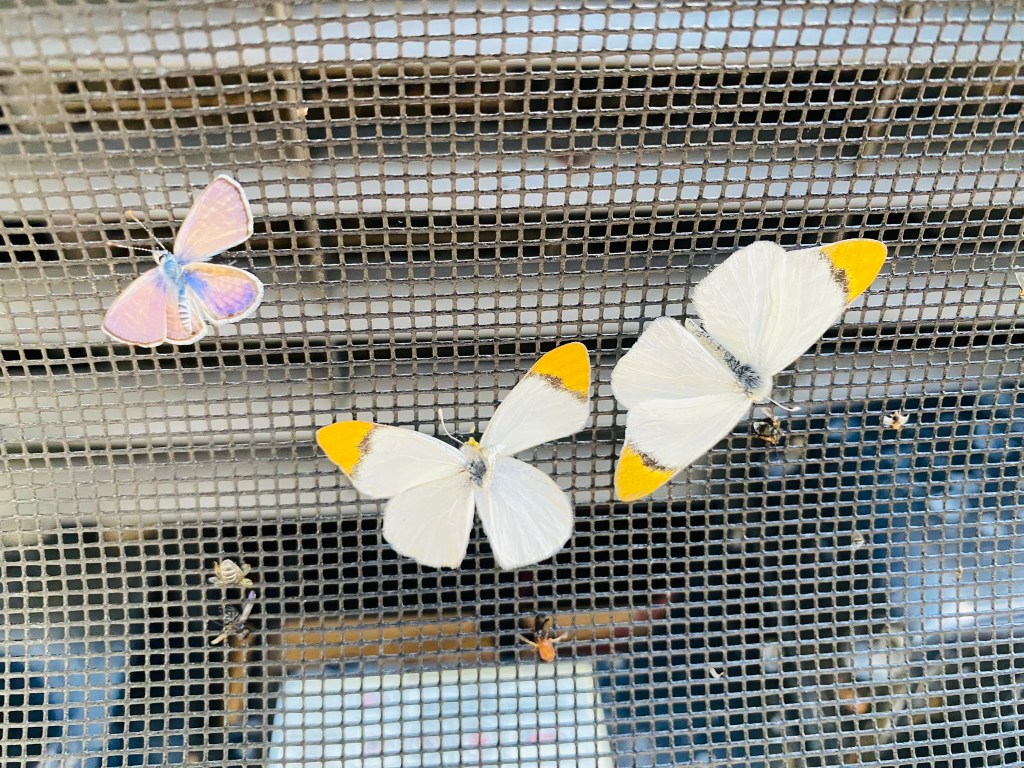
As we climbed back into Henry we noticed that his new seed net was catching more than expected. He was looking quite pretty, albeit I´m not sure the wildlife was so keen!
As we approached the border the next day we arranged to meet with a fixer who had been recommended by other Overlanders. The border into Angola is notoriously complicated and as no-one speaks English we needed someone to translate and help us find our way through the process.
We were smoothly stamped out of Namibia and, after over a year inside the South African Customs Union, Henry´s Carnet de Passage was finally stamped out as we left. Angola does not recognise Carnets so as well as trying to work out how to convert our pre-visa authorisations into actual visas we also needed to figure out how to acquire temporary import permits, pay road tax and a variety of other requirements.
Our fixer was brilliant. He walked us through the steps, ran backwards and forwards sorting Henry´s paperwork whilst we sorted ours. Angola is one of very few countries that still require a COVID test to enter but they don´t actually do a test, they just charge you not to do one! Our fixer had quiet chats to smooth all this out. The mayhem of the incredibly busy border was starting to get some structure.
It was all going well until we needed to change money. Our fixer called a friend of his who he said would give us a much better exchange rate than the usual money changers. Given the help he had been so far we trusted him and waited for the friend to arrive.
At that point it all went downhill. By now we were stamped in with visas, all the paperwork was in place for Henry and it had cost us only around €120 in formal costs for the visas and €70 in ´informal´ costs not to have the COVID test. But now the great exchange rate we had been promised for our US Dollars turned out to be very poor. And it got worse when we tried to negotiate! We just wanted to get away from the border and into the country so gave up arguing and took the Kwanza.
The friend seemed to have a bad effect on our fixer though and he suggested we paid something to the customs chief so that they wouldn´t search the Landrover – telling us that otherwise they would pull the whole thing apart and it would take hours. He suggested US$50 and we said no, we had nothing to hide, we would take our chances. The friend started expressing firmly how much trouble it would be and between the two of them they said they could probably do a deal at US$20. We agreed, keen to be on our way, and the two of them guided us to the exit.
We were pulled to one side at the barrier and sat waiting. I was getting very annoyed, if they were going to search us anyway I wanted our money back, but our money was long gone. Eventually we were waived through only to be stopped on the other side of the barrier by our fixer and his friend. One of them at each window, they told us we hadn´t paid enough and the officials wanted another US$50. We said no. They said they would not let us go, we still said no. They changed the subject and asked if we wanted a SIM card and we said we would get one from the UNITEL store a few meters away. They told us they would negotiate a good price for us if we gave them the money for the SIM. We wound our windows up and drove away. Not one border official batted an eyelid as we went but our fixer and his friend stood watching us with a mixture of anger and disappointment on their faces.
The UNITEL store was closed; the nearby kiosk selling SIM cards was very busy and the seller ignored us entirely until we eventually walked away. There were people everywhere trying to sell us things, aggressively wanting to change money and holding their hands out to us for something or other.
James was not impressed. We sped away from the border towards the nearest town. A few miles down the road we came across a large supermarket and I ran in to see whether they sold SIM cards. A woman was called to speak to me as she spoke English. She advised they did not sell SIM cards but pointed me to a shop across the road which did. I went over, the lady behind the counter could not understand me but a customer spoke a small amount of English and told her I needed a SIM card and data. She shook her head and the customer gestured for me to follow him to a kiosk just down the road. Here I managed to get a SIM card and by typing numbers into my phone got them to understand how much data I needed. But trying to find out from them how long the data lasted before it expired was impossible and eventually I gave up and just kept my fingers crossed it wasn´t a 24 hour package!
It had been a fun exchange with good humour and helpfulness on all sides. And it was very reminiscent of how we got things done in West Africa. But when we went on to a fuel station things deteriorated again. The fuel attendant was surly whilst he filled up and refused to give James any change when he paid in cash. As we drove away James had a fixed look on his face trying to hide his annoyance. ´I´m not feeling this place, I have to admit´ he growled.
As for me, it had clearly not been a smooth entry into the country and a bad taste was left in my mouth from the chaos and corruption at the border. But we knew many people who had visited Angola and loved it, plus I was determined to enjoy the challenge and find the good here. I suggested we should give the country a chance and not judge too soon. I needed a change, we both did, and we needed something new to get our teeth into. I couldn´t bear the thought of giving up on Angola before we even got going.
With no campsites or tourist infrastructure we were entirely dependent on an App called IOverlander. This is a very well known tool used by Overlanders all across the world where travellers mark places on the map for anything they think might be useful to other travellers – whether it´s formal campsites, wild camping spots, restaurants, mechanics, police checkpoints, embassies, attractions, view points. You name it, you can find it on IOverlander. When marking a place on the map you write a short review telling others what is there and how good or bad it is. If you visit a place already marked on the map you can check-in to it and write your own review to add to what has already been said. It is a very powerful and incredibly useful tool but up until now we had not been using it to its full potential.
In Angola there was very little else to go on and so IOverlander became our bible.
Having spent many hours at the border and being in such unfamiliar territory, we were keen to find somewhere safe and comfortable to camp up and gather our thoughts. Other Overlanders on various forums had recommended that we stayed at a Catholic Mission in the small town of Ondjiva about an hour´s drive from the border. But when we arrived there was no-one there other than a few children who spoke no English and who we couldn´t get to understand we were looking for the priest or the monks to speak to about camping there.
So we drove on, getting increasingly concerned about how we were going to make travelling through this country work. I got onto IOverlander and searched the map for a nearby wild camping spot. There were a remarkably large number of options. I read a few of the reviews and chose one called ´Giant Baobab Tree´. The reviews said it was quiet and beautiful and relatively easy to get to over a dirt road. We put the GPS coordinates into the sat nav and crossed our fingers.
As we drove along a surprisingly perfect tarmac road, I started to appreciate just how beautiful Angola is. The views all around us were spectacular with flat, green, almost park-like landscapes.
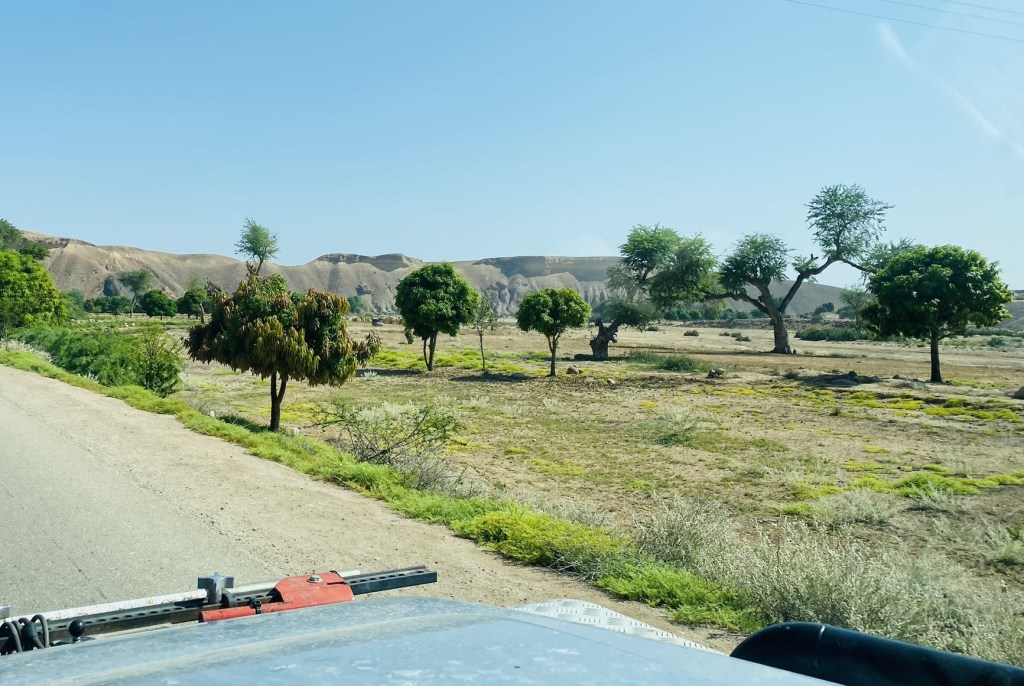
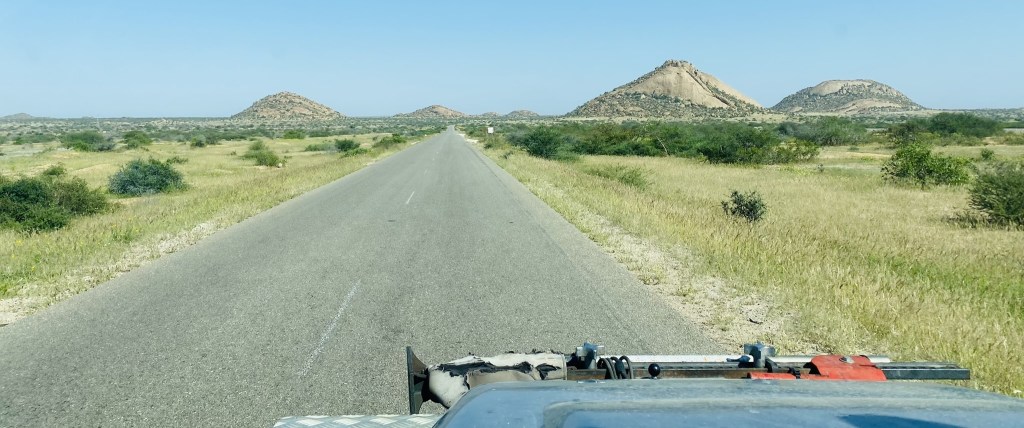
At one point a bird of prey flew overhead carrying a snake in its mouth. It was all very new and different and felt like a breath of fresh air.
But there was also a sense of foreboding as practicalities were forefront in my mind. How were we going to communicate with people? Where were we going to sleep each night? And where on earth would we find water – if we were to be wild camping every night then finding a way to keep our water containers full was paramount. We normally fill up at campsites, but there were no campsites.
All along the road were concrete structures with manhole covers on top. I started to realise these were access points into the main water pipes below – but most were sealed. Every now and again one was broken and some of the local people were climbing down inside with buckets taking water from them. We debated whether we could do the same but it didn´t seem an ideal solution – nor particularly safe. So we pressed on hoping for a better option.
At the next town we passed another fuel station and decided to fill up our side tank just to make sure fuel didn´t become another thing to worry about. As we were filling up I spotted one of the security guards filling up a water bottle from a tap by the pumps. With a huge amount of relief we unloaded all three of our water containers and filled them to the brim. We now had 60 litres of fresh water, enough for at least 4 days and it took the pressure off whilst we found our feet. And moreover, no-one looked twice as we did it and no-one asked us for any money.
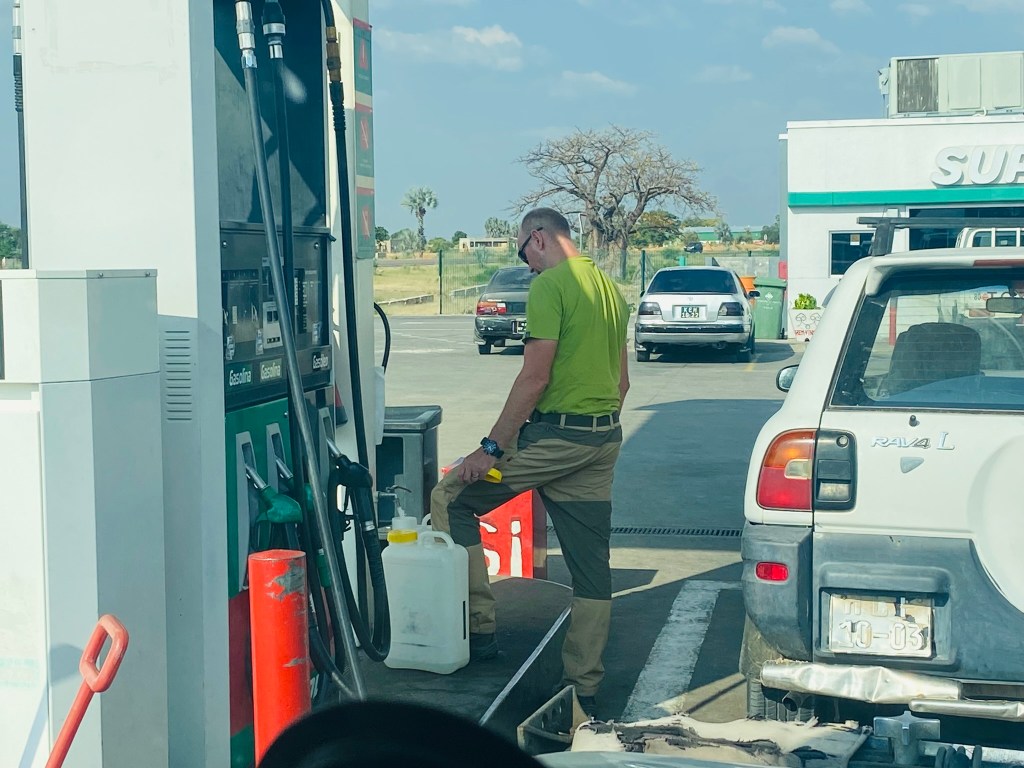
In fact, throughout our stay in Angola, fuel stations became our main source of water. There are no shortages of fuel stops in the country and they all have water taps. We used them more frequently for water than for fuel! One big concern had been resolved taking a huge weight off our minds – free, easy and available sources of fresh water. And the local people welcomed us to take as much as we needed, even sometimes running to turn on main stop cocks, finding keys for taps or even walking us to a nearby well when the fuel station water had run out.
The turn off from the main road towards our potential wild camp took us onto a dirt road through a large village. The road got worse and worse and the people stood and stared at us as we went by. I waved out of the window and was greeted with warm smiles and friendly waves back. But as the track wound its way through the village between small houses James´ mood was sinking further, where on earth were we going to end up?
The village was eventually left behind and the bumpy track continued seemingly away from civilisation. It wasn´t hard to drive but we were not filled with confidence about what we would find when we reached the location.
After about 10km we started to see a few large baobab trees lining the route
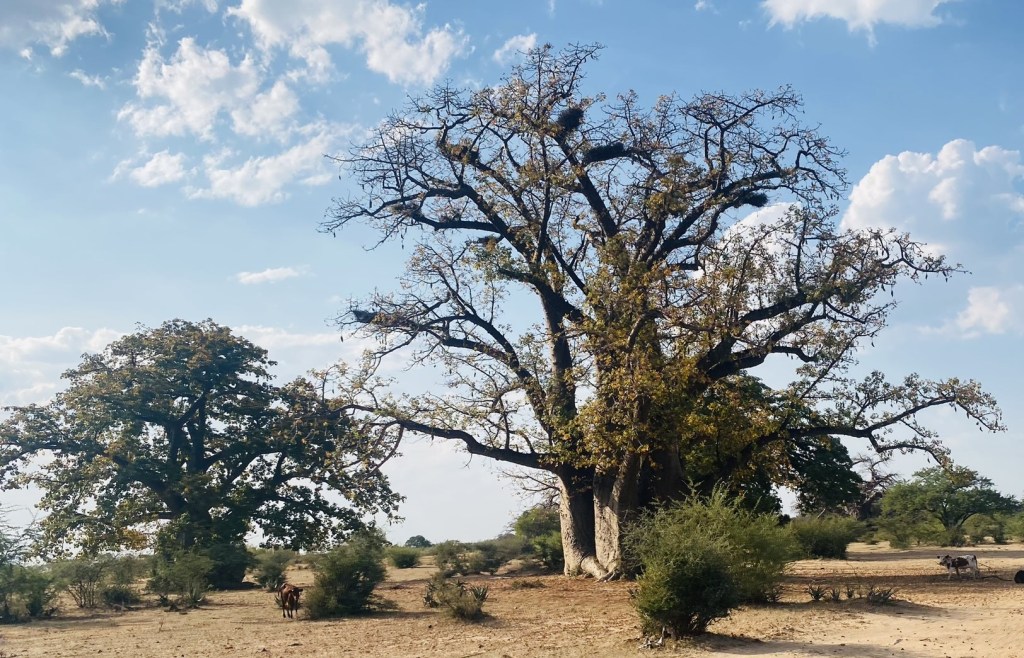
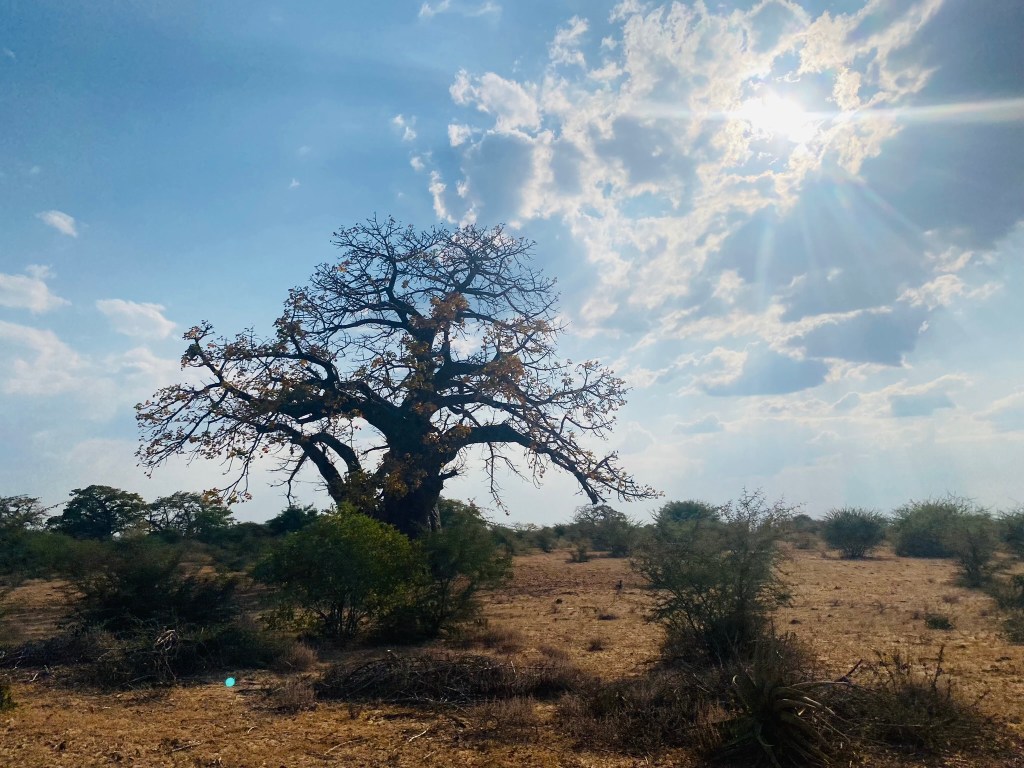
And as we approached the final GPS position we saw in front of us the largest Baobab tree I have ever seen!

The whole area was lovely. Peaceful, remote, clean. We found a spot near a clump of trees where we could tuck in and set up camp.
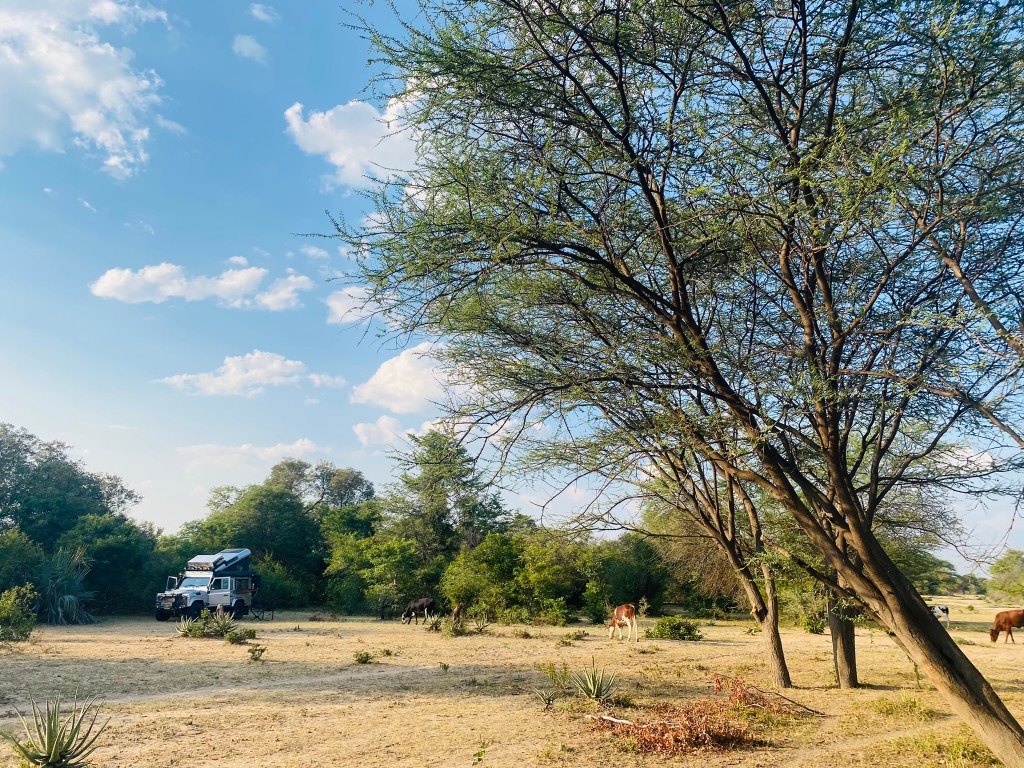
All of a sudden, a sense of calm came over us. Maybe this wasn´t so bad afterall, maybe it was actually quite lovely.
Later in the afternoon some people started walking past. They seemed to be walking from a nearby village to a source of water as they all returned in the other direction carrying big containers. Everyone looked at us in surprise then smiled and waved with a happy ´Bom Dia´. We initially replied with ´Ola´, being what Google Translate told us was Portuguese for Hello, but after a while we realised that returning the ´Bom Dia´ greeting (Good Day) was the expected response.
The people seemed shy but not unhappy about our presence. At one point a couple walked by with a small child carrying a radio booming out dance music. We waved and I danced to the music making everyone laugh.
We settled in for the night with a beef stir fry and a movie until too many mosquitoes finally forced us into an early night.
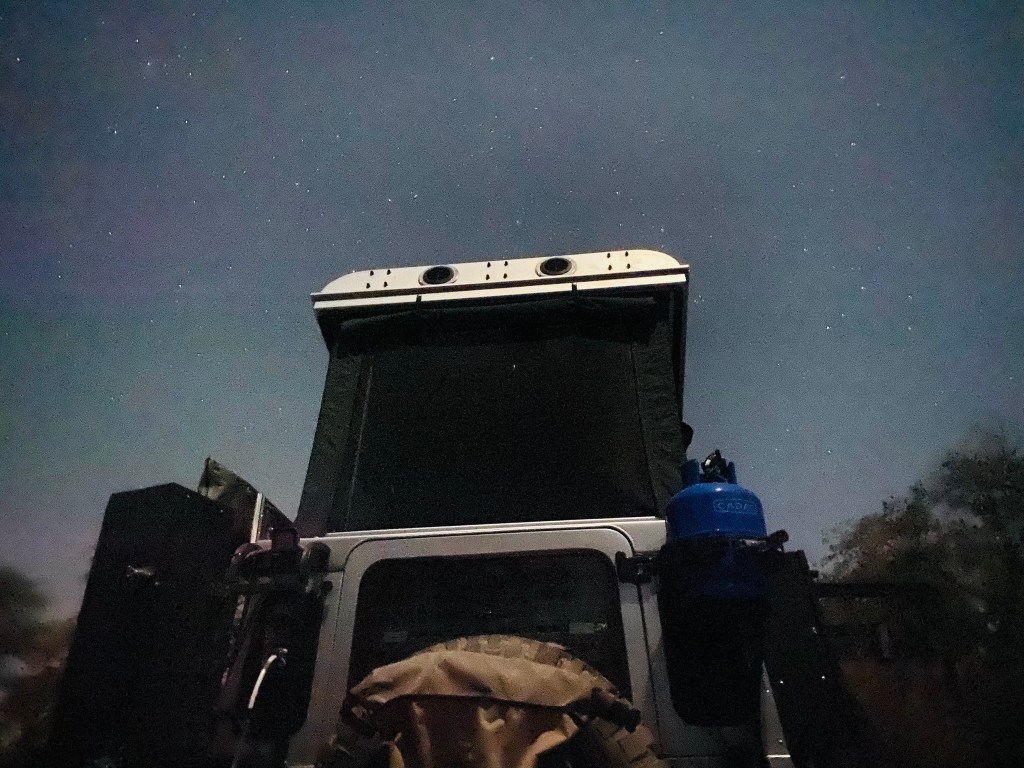
One other difference in Angola is time – the country is, surprisingly, an hour behind Namibia, Botswana and South Africa. So when I got up at my usual 6am it felt like I´d had a lie-in. As I started my training, the locals passed by and looked at me with amusement. One family stood and watched for a while then shyly asked whether we had any food using hand gestures. I gave them an apple and a breakfast bar and they seemed incredibly grateful and delighted. They stood sharing it out between them and eating it there and then saying thank you again and again.
Two ladies came and sat by the large Baobab tree with their washing. As I went over to take photos of the tree they smiled and laughed at my lack of Portuguese and made hand signals to communicate how impressive the tree was.
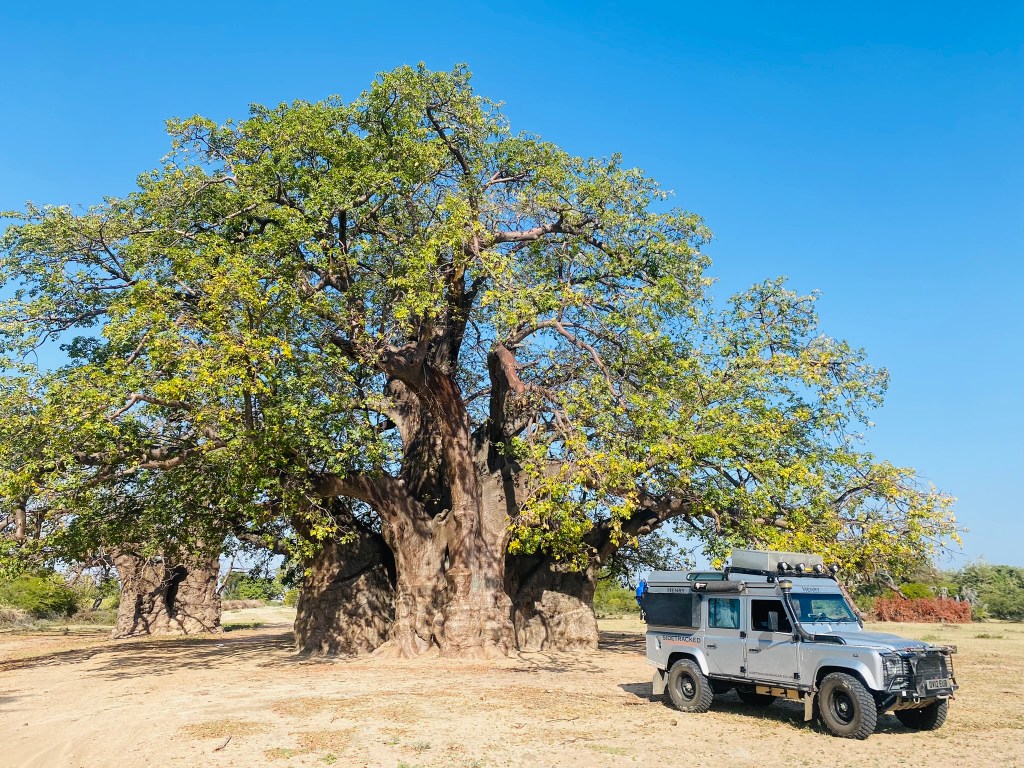
It was like a veil had lifted on this country and a weight had fallen off our shoulders. We may have had a rough entry into Angola but since leaving the border everything had started to fall into place. The people were incredibly friendly, gentle and quite shy. And everyone seemed so happy. The landscape was breath-takingly spectacular. Fuel was cheap (22p per litre!) and water was both free and freely available. This gorgeous wild camping spot gave us confidence that finding places to sleep each night would not be so hard and our lack of language skills was taken in good humour by the locals.
So as we drove away from our Baobab tree and the smiling villagers we were full of optimism. An optimism which was reinforced and strengthened every day as we travelled through this unique, welcoming country which proved to be absolutely, jaw-droppingly stunning in every way.
A few facts about Angola –
Every part of it is stunningly beautiful!
It is one of the largest countries in Africa. The population is around 32 million, compared with 2.5 million in Namibia and 2.6 million in Botswana – on average 26 people per sqkm rather than 3! So there are people everywhere (making quiet bush wees and lunch stops quite hard to find).
It is a very wealthy country, rich with oil, minerals and diamonds. But chronic high level corruption means that the people see very little of the wealth whilst those in government get very, very rich. We heard many people express outrage that such a wealthy country in the 21st century has a population which has little education, poor health services and where most children outside of the major cities play in the streets rolling tyres with sticks and have never seen a television.
The average age is 17 years old! This, I can only imagine, is a combination of the huge death toll inflicted by the war of independence and the civil war – which between them lasted 40 years from 1962 to 2002 – but also the very high birth rate. As we travelled through the country it was a rare sight indeed to see a woman over about 14 years old who was not pregnant or carrying a baby on her back, or both. Children are everywhere. They walk to school in big groups along the roads every morning and back every lunch time before spending the rest of their day working – carrying wood and other provisions, gathering water, herding animals or selling goods at the road side.
The white population of Angola is not Afrikaans. They are Portuguese and most retain very strong ties to Portugal rather than to South Africa. There was never anything like Apartheid here and so now there is no racism. Everyone is equal, everyone gets along and there is no concept of ´us´or ´them´.
Everyone seems happy. Most people have very little in the way of material possessions. There are always the middle classes and the wealthy in the larger cities, especially the capital, Luanda. But outside of that, in the towns and villages, most people have the clothes they stand up in, a small home they built themselves and the food that they grow. But what they do have is something which has disappeared from life in many European countries – community. People walk for miles with heavy loads of wood, water containers or baskets of provisions on their heads. They have done it every day of their lives since they were able to walk and will continue to do it every day until they die. Young, old, men, women – they work hard, their lives are relentless and often they look worn out. But they are walking with their daughters, their mothers, their sisters and their friends. They chat and laugh as they walk. They sit at the roadside for endless hours trying to sell fruit, vegetables, wood or charcoal. But they sit with their families and their neighbours. They braid each others´ hair, mend clothes, tell stories. They are supported by the people they love most in the world, a wide network of community always there, always looking out for each other, always sharing what little they have.
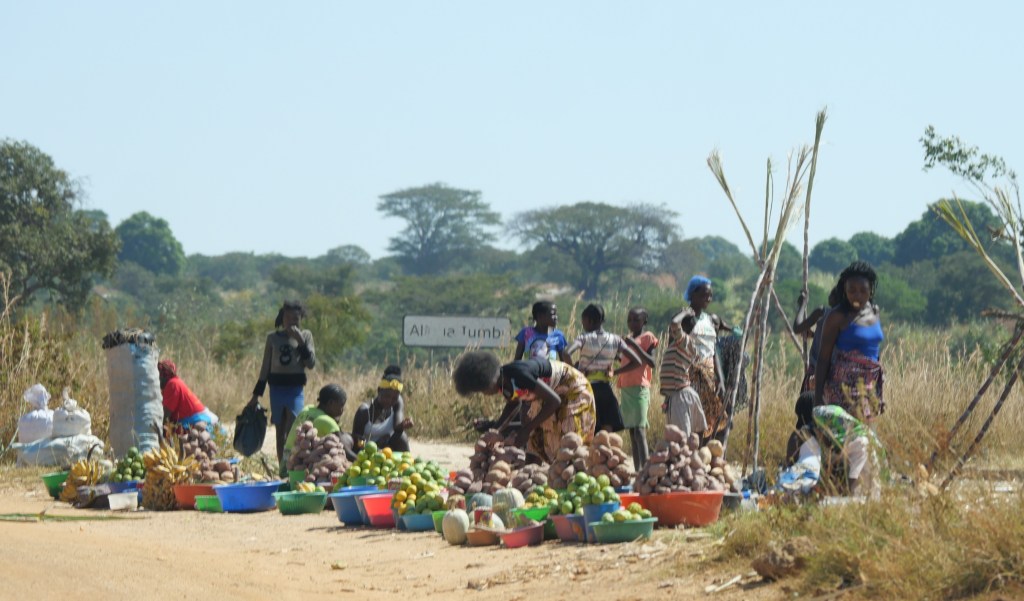
And there is very little crime.
A month in this country can change everything you thought you knew about the world. A month surrounded by people who will rush to your help even though you´re a complete stranger. People who will welcome you and give what they can, asking for nothing in return. People who have no thought about how they can get something from you but rather are happy just to see you there. Children whose eyes light up when they realise you are offering them a biscuit, a crayon, an apple or a box of eggs, but who wait politely and patiently for you to hand it to them and then share it with their friends.
Our story in Angola is one of the best we have experienced to date. And it all started with a Giant Baobab tree…..
 The Sidetracked Sagas
2 responses to “A Crash Landing in Angola”
So pleased things are settling down…. As you know I adored Angola. I particularly remember all the women calling me ‘Amiga’.
Enjoy the fabulous country.
LikeLike
Another great blog but the start with the fixer really does stamp down the fact that everyone who smiles at you is not your friend and even the devil was an angel once . But an amazingly positive outcome at the end. Maybe you should be tourist advisors for Africa because what the media portrays is corruption, disease and crime and what you portray is genuine people who would give you there last crumb of food. Genuine people who have nothing in life apart from happiness and love. How giving were people during our years of war and depression everyone was in the same boat no better no worse . Your blogs really should install optimism in the human race
LikeLike