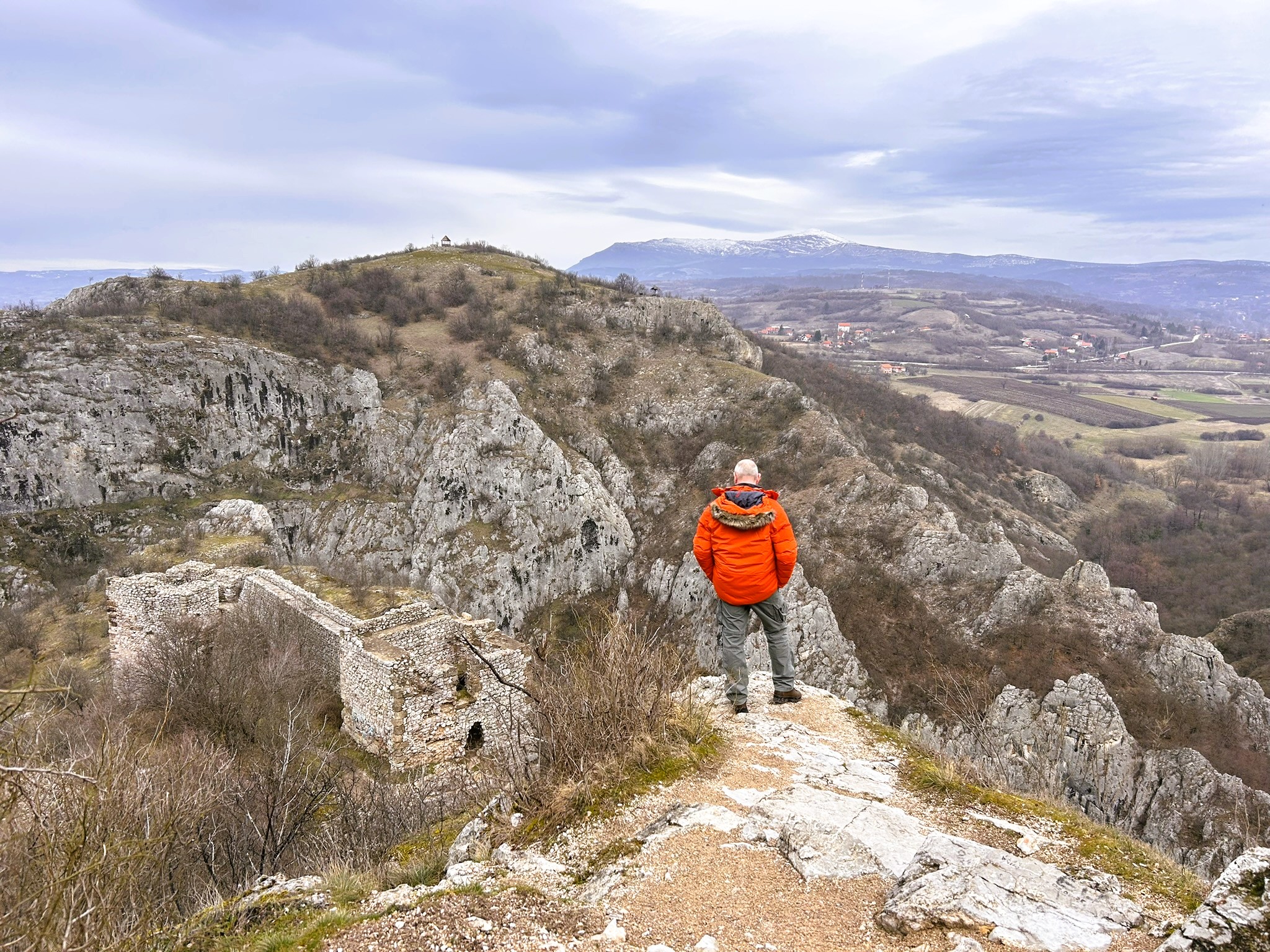
We were determined to be hopeful – the first buds had started to appear on the ground and, whilst it had snowed yet again, it was thawing quickly and the sun was feeling distinctly warmer.
We packed up after our peaceful night by the Roman palace and headed off to Lazar’s Cave. But when we arrived it was closed


A quick call to the tourist information office told us that it didn’t open until May and it was only the middle of February.
Undeterred, we decided to go for a snowy walk to a viewpoint over Lazar’s Canyon


The path was steep and slippery in the ice

But the views were beautiful

Especially when we arrived at the official viewpoint

We even made another snowman, something we didn’t expect to be doing again, although he looked a bit more like a snow alien by the time we’d finished

Back down in the valley we found the river


With a fun suspension bridge

And another crossing that felt a bit more perilous….and wet


We wanted to get to Kupaj Spring for the night but our sat nav was having other ideas. It took us on a ‘short cut’ over mud roads

The road got narrower and muddier until it eventually ended abruptly in a snow drift that even a UniMog wasn’t going to plough through. So we had to turn back and try again, this time staying on tarmac


As we drove, we descended further into the valley and finally left the snow behind

We were tired and relieved to eventually make it to the springs and find a large, flat car park for the night.
We hadn’t been sure what to expect from Kupaj. We had no doubt that it would be lovely in summer when we could swim and lounge around having cool drinks. But in the middle of winter it might be a little harder to amuse ourselves.
We needn’t have worried


The thermal pool was pretty


And the small lake and cave further up were lovely

With crystal clear, blue water


All along the edge of the river were trout ponds


It was fascinating to see thousands of the fish dashing around. These ones were the babies

The next pond along housed the teenagers

And the last one had the adults, but I couldn’t get a good photo of them as the sun was glinting off the water too much.
There were signs up promising cheese sold by the kilo but everywhere seemed disappointingly closed. So when an older couple appeared who were clearly the owners, I ran over and asked whether they had any for sale.
The did and I became the proud owner of 1kg of tangy, salty and delicious Serbian cheese and am still eating my way through it some six weeks later

Having been disappointed at Lazar’s Cave, we tried again at Resavska Cave and this time we were in luck. We arrived just after midday and there was a tour going at 2pm

These caves were beautiful


We walked through magnificent halls


Full of stalactites and stalagmites


And some rocks that looked as though they had been folded


It started to get a bit tight towards the end but, just as I was reaching for James’ hand, we popped out into fresh air again.
Our next stop was Veliki Buk waterfalls. We parked up close by and walked down a well-marked path that took us first to the top of the falls


And then down to the bottom


It was only small but very peaceful and the eagle-eyed of you may have spotted James’ attire – no big winter coat! It was distinctly warmer and we were revelling in it.
I realised that we had been out of towns and far away from anything industrial for days and it was wonderful. I couldn’t help but wonder why Serbia is not a much bigger tourist destination – it has everything from history to nature to culture. It was quickly turning into one of our favourite places.
To prove the point, we went from caves and waterfalls to another cultural icon – the Manasija Monastery, a 15th Century fortress which holds the tomb of the Serbian despot Stefan Lazarevic.
It took a while for us to get used to reading about ‘despots’ without thinking of oppressive dictators – in Serbia it simply means Prince. In fact Stefan Lazarevic is a Serbian hero, considered a great knight and military leader who gained independence for Serbia in around 1400.
Sadly, no photos were allowed in the church where his tombs lies, but I made up for that by taking a thousand photos of the fortress itself


It was so picturesque


We found a guide to take us up to the ramparts and looked down over the church


We had been doing so many wonderful things that it was time for some chores – the endless round of laundry and shopping. We headed for the town of Cuprija and parked up on the edge of town opposite a large cemetery.
It wasn’t exactly pretty but it was relatively quiet and seemed safe enough. We spent the rest of the day doing laundry, food shopping and some desperately needed Mog cleaning


Fortunately, Serbia is full of car washes – clearly we weren’t the only ones needing their services on a regular basis.
After a day of chores we wanted some excitement but it was not to be.
We drove to Bovansko Lake

It was nice enough – and very big – but the day was grey and it had started to snow again so it fell a bit flat. We had hoped to drive the long, circular trail around it but when we got there it was far too narrow for BigMog.
So we pressed on to Vrmdzancko Lake but again found the roads to it unpassable and turned back.
Our final stop of the day was to be Seselac Cave, another place that we expected to be hard to get to. We feared that our entire day was going to be wasted.
The cave was over 600m up and, as we drove, the temperatures dropped and snow started to appear on the ground again

The road got narrower and muddier with overgrown branches and deep snow. It was only just above freezing and we were sick of it. We stopped to assess whether or not to continue but in the end decided to throw caution to the wind and go for it.
BigMog pushed through the branches, dug his wheels into the snow and mud and pulled us around the final bend, safely into small car park which had clearly not been used by anyone for quite some time. The snow lay untouched and we had no idea what was under it. As we pulled in, we heard cracking under the wheels but it was only the ice, the ground beneath was solid

We found a level spot, got the ladders out and dashed inside to warm up

It was only 2pm but we had not had the best of days and were ready to just curl up with a cup of tea and a good book.
It was minus 1 when we woke up and I trained in the snow yet again. But it was somehow fine – our positive vibes were still intact.
We walked along the pretty, woodland path towards the cave, passing a lake on the way


Seselac Cave is very understated, there are no gates, guides or tickets to worry about – it’s just there for anyone who wants to poke around

We found it fascinating


It was surprisingly big inside

With lots of passageways leading to who knows where

We even found two small bats curled up on the ceiling

In the entrance there was snow and ice

But the deeper we went in, the warmer and dryer it got

And it was pitch black, the only light coming from our torches

All the previous night I had been worried that it would snow again and we wouldn’t be able to get back to the main road, but my fears had been groundless. BigMog didn’t miss a beat as we slowly made our way back down the track

And we were soon driving off towards the spa town of Soko Banja.
For all that the previous day had been disappointing, today turned into one of our best. Not only had the cave been fascinating, Soko Banja was a very pretty little place that felt friendly and welcoming

We found the old Turkish Hamman and went inside to see what was on offer

The lovely manager showed us two separate spa pools, either of which we could have exclusive use of for 30 minutes for just £13


We were thrilled and booked one along with a back massage each.
It was a couple of hours of rare luxury for us and we left feeling rejuvenated, finishing the whole thing off with a lovely meal in a nearby restaurant.
We headed to the old fort town of Soko Grad to park-up for the night

I had eaten far too much at lunchtime and was feeling a little uncomfortable so I decided to go for a quick walk which looked as though it was circular on the map

It was lovely

But just as I thought I was nearly back at the Mog, my path abruptly ended in a cliff edge and the rest of the road was a bit lower down than I had anticipated!

It was a long walk back….
Soko Grad itself is a ruined fortress perched high on a cliff. We bundled up in our warm coats the next morning and started the trek up.
At first it was a lovely walk along the river

Although we did have to do a bit of paddling at the beginning

We had read that the last few hundred metres were a rock scramble, and some people even said you took your life in your hands going up. So we weren’t sure whether we would make it all the way. We were very close to the top and so far it had been a little steep but easy enough. But just as we were starting to feel confident, we found the cliff face

James can climb up and down anything, he’s like a mountain goat. I’m pretty good at climbing up but am embarrassingly hopeless at getting back down again. James looked at me questioningly but I was determined to get up there and worry about the descent later.
So up we went


The views were worth every last scramble


Picture perfect


I tried hard not to think about how I was going to get down until I really had to and in the end I came up with the perfect solution

I came down on my bum!

High on my achievement, our next stop was the village of Ozren where we found the Ripaljka waterfall

It was only small but the walk down to the bottom was pretty

As was the walk around the village itself


After a quick lunch we carried on to the Bubanj Memorial Park, on the edge of the city of Nis, where we planned to stay for a couple of nights.
This monument is made of three fists of different sizes depicting men’s, women’s and children’s hands defying the enemy. They symbolise the 12,000 people who were executed on this hill by the Nazis during WWII

We had a quick wander around, soaking in the atmosphere


And found a new mum with her puppies in the middle of the park


As usual in Serbia, the locals were taking care of them providing a house, food and water to keep them going.
It had been a long day so we settled in for the night, trying not to notice the busy traffic going past on the main road.
Nis is not the most exciting of places but it does have two things worth seeing – Skull Tower and the Red Cross Concentration Camp. Both are symbols of past atrocities inflicted on the Serbian people by would-be oppressors.
We had no appetite for driving into the city so the next morning we headed for a bus stop and when the bus arrived we discovered something new about Serbia – all public transport is free! The bus driver waved us away when I tried to give him cash and the other passengers called out to tell us it was not needed. It was a revelation.
Our first stop was Skull Tower, built by the Turks in 1809 and originally consisting of 952 skulls embedded into the walls. The skulls were those of Serbian soldiers who lost their lives in the First Serbian Uprising


It had been intended to instil fear into the locals and keep them discouraged and subdued but had the opposite effect. It became a symbol of pride, a reminder of the country’s struggle for independence, with thousands of people making a pilgrimage to see it every year.
Most of the skulls have fallen from the tower, been removed by relatives or even stolen by souvenir hunters so only 58 remain


A church was built around the original tower in 1878 to help preserve it

It was a gruesome but thought-provoking visit.
We then jumped back on the bus to the Red Cross Concentration camp – a desolate place


Up to 35,000 people were detained here during the war in unimaginable conditions. 10,000 were executed and the rest were deported to other camps across Europe


The main block is now a museum


Where you can see writing on the walls, messages of both hope and despair scrawled by the victims


After two such powerful monuments to the devastation of war, we were in need of cheering up so walked across town to an astonishingly good Chinese restaurant and then found ourselves in a Stihl shop on the way back to the Mog where I bought James a chain saw for his birthday – what every Nomad needs!

During all of our recent explorations, BigMog had been happily plodding along, doing his thing and not causing any problems. It was tempting to let him get on with it and hope everything carried on like that, but James was keen to spend a bit of time checking him over to see how things really were.
So we found somewhere to park-up that was flat and tarmac and settled in for the night. It wasn’t pretty, in fact it felt as though we were in the middle of an airport or industrial estate, but it was quiet enough and no-one bothered us.
James spent the next morning checking the portals and finding that they were all good. He also replaced the o-ring on the fuel tank sender as it had become loose and fuel was now leaking out of the top as well as the bottom of the tank. This was less successful and we were beginning to think that the only solution was whole a new tank

We were in the deep south of the country by now and our next stop was to be our most southerly point – the hydroelectric plant at Vucje

This historic building has been continuously operating since 1903, one of the oldest in the Balkans

We were disappointed to find there was no visitor’s centre, but the river downstream had been made into a tourist spot with benches and a picnic area

As always, it would be lovely for swimming in the summer but for now we stuck to walking around it


And we certainly didn’t fancy the slides!

We had expected to be staying here overnight but it was too early in the day to park-up so instead we drove to the Empress’s City – Justiniana Prima – another Roman ruin, this time dating back to the 6th century.
We arrived just after 5pm and found a large, flat and completely empty car park – the perfect place to stay.
The weather had been slowly but surely improving and we had had a little celebration earlier in the day as BigMog’s temperature gauge told us it was a tropical 13 degrees

It also hadn’t showed any sign of snowing for a few days.
It wasn’t quite so warm the next day as we wandered around the site but we had little to complain about


The Empress’s City was huge and it took us all morning to get round it


There were even some sign boards to tell us what we were looking at – lots of churches


The Acropolis


And various residential buildings and streets


Typical of Serbia, we had tried to buy tickets at the visitor’s centre but, whilst it was open, there was no-one there. So after seeing the ruins we went back to try again and this time found someone at the desk. It was quite hard to persuade her to take our money but eventually she relented and sold us tickets.
She also played us a video of a 3D model showing what the city would have looked like back in its day which brought the whole thing to life.
From there we made our way west towards Devil’s Town. As we drove, we gazed out of the window at the endless rolling farmland on either side

We were really enjoying driving through the beautiful countryside and were feeling very relaxed.
There are a lot of birds of prey in Serbia and as we drove we frequently saw eagles, hawks or falcons flying overhead, diving for their prey or just sitting in the trees. They were magnificent with their huge wingspan stretching out across the sky. At one point an eagle flew up right in front of us and we had to brake hard to avoid it hitting the windscreen.
We passed over Radan mountain

As we neared the peak we started to see snow again and the temperature noticeably dropped, but once we were safely back down to 1,100m we stopped for lunch and the world was looking beautiful again


Devil’s Town itself was much lower down and by the time we arrived in the late afternoon it was lovely

The sun glinted off the mountains and everything was bathed in a warm glow


The place reminded us of the wild west

With the addition of some unusual sculptures hidden amongst the trees


The ticket office was closed but the gates were open with a welcome sign above so we went in and started walking the trails through the forest. The first thing we found were the openings to the old mine shafts


This one was up a small slope that turned out to be gloopy mud, turning James’ boots bright orange

The Red Well is a natural spring that is highly acidic and iron-rich, staining the ground all around

Near the top was the small church of Petke where believers wrap white cloth around the nearby trees to ward off disease

Inside is an unusual icon – an ant on which has been painted the image of a saint

We didn’t have a magnifying glass with us so just had to believe it!

Finally, we made it to Devil’s Town itself – a rare natural phenomenon of 200 pillars formed over millennia by erosion, the stone caps protecting the earth beneath them


We couldn’t have asked for a better setting, the late afternoon sun glancing off the pillars


It was gorgeous


We climbed to the very top of the observation tower where we had a magnificent view over the forested mountain slopes

There are a few legends surrounding these pillars, the most famous being that they were wedding guests who angered the devil and were turned to stone. Another is that they were students who lost a bet with the devil and a third that they are devils themselves.
Whichever story you prefer, the whole place had an enigmatic and eery feel and we loved it.
So much so that we decided to stay the night in the car park and slept soundly in perfect peace and darkness

We had been doing our best to dodge the cold and the snow as much as possible. So our next stop was one which we were not sure was a good idea – we were heading to the highest peak in Serbia and its most popular ski resort – Kopaonik.
I had planned this carefully, making sure we could get all the way up and all the way back down again in one day, saving us from a freezing cold and snowy night. The last thing we wanted was a frozen toilet again!
As we started off, the roads were pretty and the weather was lovely


But an hour later we were high up and it was getting very cold

By the time we reached the ski resort we were 1,800m up and thick snow lay all around

The town was heaving with people, all here for the skiing. We watched them strutting around in their ski gear and couldn’t help but shiver, remembering Sarajevo.
There was no chance of parking in any of the car parks, the whole place was full. So we found a spot just outside town and pulled over. We had intended to find a nice restaurant but we were too far away to walk back so ended up with pizza in the truck

We weren’t too disappointed by this, there is a distinct feel that is common to all ski resorts whichever country they are in – from the alpine architecture to the high cost of everything – and we only had a passing interest in it

It also meant that we were heading back down to warmer temperatures much earlier than expected and any risk of being stuck up there overnight was gone.
We had now followed the Kosovo border all the way from the east, over the top to the west and were travelling south again towards the Crna Reka monastery. To get there we had to pass through the town of Novi Pazar and for the first and only time in Serbia, we felt a little uneasy.
The town felt very moody, there were piles of rubbish heaped up several metres high along the roadside and everywhere seemed very rough and gritty. The traffic was chaotic, many streets were gridlocked. We inched our way through, cars coming at us from all directions.
Eventually we made it out in one piece and were thankful to be on the open road again

We made it to within 2.5km of the monastery, on a small dirt road alongside the Crna river, and decided to park-up for the night ready to go and see the monastery the next day


Crna Reka is not like any other monastery, this one is hidden away amongst the cliffs of the Mokra Gora mountain range and actually carved into the rocks
As soon as we arrived we loved it


The new monastic building was a beautifully built stone house, very similar to something we would love to build as our forever home

The old church, tucked away in the rocks, was very atmospheric


As we crossed the wooden bridge, a monk hurried past us waving a key saying that he would open the chapels for us.
We poked around inside for a while, peering into the tiny, carved spaces


And looked out from the vaulted terraces


Three other visitors had gone into the main chapel with a priest and closed the door. We heard chanting and one of the women was crying. We didn’t want to disturb them but eventually the door was opened and we were invited in

I stood inside the tiny space with the other four people, all of them kissing various icons and chanting in a long, ritualised sequence that we had seen in every church we had visited across the region and would continue to see many more times. One woman looked at me, pulled my (very cold) hands out of my pockets and gestured for me to go ahead and do the same. I smiled and declined the offer, earning myself a kiss blown in my direction.
We were on a roll with monasteries, the next one was Gradac


This was completely different from small and isolated Crna Reka. In fact, for the first time in many months, there were many other people visiting.
It was the week-end, the sun was out and the day was beautiful

There was a baptism taking place inside the small church which explained a lot of the other visitors. I poked my head inside the door for a moment to see inside


But then left them to it whilst we walked around the grounds then climbed up to the top of the tower and looked down


Apparently Queen Jelena was buried here in 1314 and being somewhere with such a long history was fascinating. But the best part of it was simply sitting on a bench in the sun, warming ourselves under the blue skies and dreaming of summer….