We were in Belgrade, a place we had gone to great lengths to avoid for weeks but had now dived into – determined see everything Serbia had to offer whether we liked it or not!
Our first day had surprised us, with the wealthy district of Dedinje being rather quiet and green. We assumed that the rest of the city would be very different but we were wrong.
Just as everything we thought we knew about Serbia itself turned out to be wrong when we actually got here, so too were all our negative stereotypes about Belgrade.
It is a large, sprawling, brutalist city as you would expect for a place largely built in communist times. But that is not the story of Belgrade. Belgrade is, in fact, a beautiful city.
Not beautiful in any traditional way with a quaint old town full of tumbling down buildings. But beautiful in a much more striking and modern way.
Yes, it is full of brutal tenement blocks and even the new buildings appearing all over the skyline are designed in a similar style. But these are nothing more than a backdrop – the structural bones so to speak.
In amongst these bones is where the real city lies – open parkland spaces, wide tree-lined avenues, art nouveau and ottoman buildings scattered around.
There are musicians on every street corner, artwork everywhere.
There is a sense of space, of calm and peace and certainly a sense of safety. Belgradians sit on benches, ramparts or old ruins and watch the world go by, soaking in the landscape and enjoying the calm of a busy city that seems to be happening somewhere in the distance

The Danube and the Sava rivers wind their way through the town with swans and geese lazily drifting past giving you a sense that you are surrounded by nature even in the densest urban jungle.
The tenement blocks themselves are an interesting study in urban design. They are most definitely not pretty. But each block contains a number of buildings arranged in a square with large, green spaces in the middle, a children’s playground, a small sports pitch and plenty of benches. They exude a sense of community and belonging.
But this revelation was yet to come. For now, all we knew was that there was a lot to see in Belgrade so we were going to be here for a while. We decided to take advantage of that and find the authorised Mercedes dealer to order some parts for the truck – all Mercedes parts have to come from Germany and take 10-15 days to arrive by which time we are normally long gone.
In order to get to Mercedes we had to drive right through the heart of the city – something which caused dread in our hearts.
But it was surprisingly fine, the roads were large and wide and the traffic well behaved.
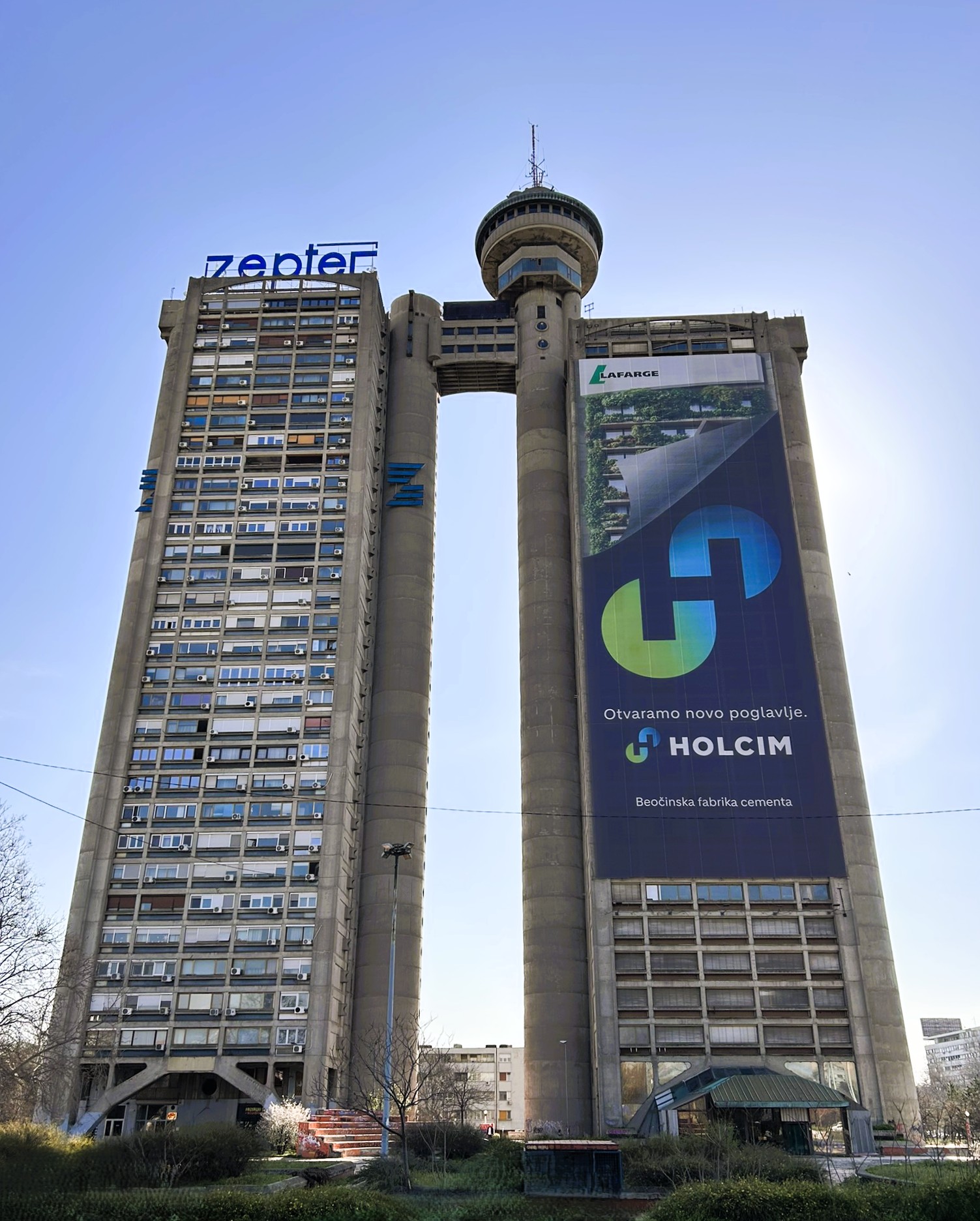
Enroute we spotted one of Belgrade’s most identifiable landmarks which dominates the city for miles around – the Genex Tower

Two huge towers connected by a sky bridge, sadly not accessible by tourists but intriguing to see as we sailed past.
We visited Wurth for some tools. They sent us to a mechanic who looked at the clutch


He found air in the cylinder which he released but it didn’t help the problem. He also had a friend who sold oil so we ordered the engine oil we needed to service BigMog and he brought it to us within the hour.
We then drove to an HGV parts supplier to order some portal oil and finally made it to Mercedes where we ordered seals for our central tyre inflation system (CTIS) which had been disabled for weeks because it was leaking.
Everyone we met was incredibly friendly and helpful and we got a lot done.
We parked up on the eastern side of town in a supermarket car park. It was a little noisy but convenient and we carried on with our chores and shopping the next morning before moving to a different supermarket with better bus connections.
Eager to start seeing more of the city than the industrial areas, we jumped on a bus heading for the area of Belgrade known as Zemun – taking full advantage again of Serbia’s free public transport.
Zemun is a pretty neighbourhood on the banks of the Danube which used to be a separate town and indeed in a separate empire – the Habsburg Empire. It has a very different, small-town feel, distinct from the rest of the city.
We started at the old Air Force Command building


And then wandered around soaking up the atmosphere and admiring the beautiful buildings


As well as the numerous little restaurants along the river

It was hard to remember that we were in the heart of the capital.
We went into the Orthodox Church to see the frescoes

Then headed to Millenium Tower which was actually built in 1896


The views over the city from the top were lovely and you could see clearly where Zemun stopped and the city-proper started

Next door was the Zemun cemetery with its life-like carvings on many of the graves


They seemed very poignant.
We then wandered back to the bus stop along the river

And by the time we got back to BigMog we were feeling decidedly relaxed.
Despite having had two lovely days exploring, we were still convinced that the rest of our visit would be busy, noisy and stressful. It wasn’t until the next day that our perceptions really changed.
We had got the bus into the very heart of the city with our first stop to be the Palace of Serbia – a grand name for the main government building. As we walked from the bus stop to the Palace, we found ourselves on wide, tree-lined avenues with new buildings rising above us on one side and a large park on the other


The Palace came into view

Not much to get excited about but the surroundings really were


This was the centre of the city.
We walked through the park towards the Great War Island and passed the Eternal Flame, a monument to those who died in the NATO bombing of 1999

We couldn’t get on to the island as the bridge across wasn’t open at this time of year. So we pressed on to the Museum of Contemporary Art

The exhibitions included Yugoslav and Serbian art from the early 20th century which I loved


Some rock sculptures which neither of us could fathom, and some absolutely stunning photographs from Paul Strand


It was going to be a big walking day today if we were to get round everything we wanted to do in this part of the city. We crossed the bridge to seek out the KC Grad cultural centre

From there we got a great view of the modern buildings on one side of the river

And the old industrial buildings on the other


The cultural centre was in one of those old buildings but it was closed so we wandered down the Sava Promenade then headed to the Brix and Buns café for a surprisingly good lunch of pulled pork burgers.
After a quick detour on another bus to buy a bag for our winch gear from a military shop, we headed to the old part of town – Kosancicev Venac. It was lovely with pretty buildings everywhere


We found the Cathedral of Saint Michael the Archangel


The art deco French Embassy

And the Residence of Princess Ljubica

Despite this one not being on my itinerary, as soon as I saw it I wanted to go in – but that had to wait for another day, as would the fortress which we could just see through the trees of yet another park

We walked back to the bus stop down Knez Mihailova, the main pedestrian street


It had been a long and tiring day but we had completely fallen in love with Belgrade.
We started the next day by taking the bus one stop to a laundrette in one of the tenement blocks after which I was going to walk to another block for an appointment with an acupuncturist whilst James got the bus back to the truck. It was a bit risky as he had no data on his phone so we walked to the bus stop together and waited until the right bus appeared – from there little could go wrong!
As we walked along James suddenly stopped and nudged me to look up

We had found ourselves standing right next to the Genex Tower. It looked even more impressive this close up but how had it crept up on us like that?
Once I was fully acupunctured it was time to go back into the city, this time to spend the day at Kalemegdan, otherwise known as the Belgrade Fortress

Originally constructed in the 3rd century AD, parts of it have been built and rebuilt over the years by the Romans, Ottomans and Astro-Hungarians so it is quite eclectic


We started at the military museum where dozens of old tanks and artillery were displayed around the edge of the fortress walls


The ramparts were extensive


And parks had been created within both the inner and outer walls


It was a huge place and it took us most of the day to see all of it


We finished our visit at the Ruzica church where soldiers in WWI had made chandeliers from spent shells and weaponry


On our way back to the bus stop we saw the ruined site of the National Library, bombed in 1941 destroying priceless archives


The next day found us doing chores again, not least of which was a trip across town to see a workshop recommended by the HGV store where we had bought our portal oil. The workshop made fuel tanks and it had become clear some time ago that our leaking tank was beyond salvage and needed replacing. The guys at the workshop seemed to know their business and quoted us a reasonable price for making and fitting a new tank so we placed the order – it would be ready in five days time.
We moved BigMog back to the first supermarket as we had been at the second one for three days and felt it might have started to look like we’d moved in! Unfortunately this one was rather less convenient for buses and we found ourselves walking along a busy dual carriageway trying to find a stop.
But we got there in the end and took two buses to a different part of the city.
Our first stop was the Slavija roundabout which we had heard had fountains and music. There were fountains

But no music. So we quickly moved on and headed to the Church of St Sava

This is another of Serbia’s most important churches and has been under continuous construction since 1935 – it’s almost finished but they are still laying the paving stones around the outside

It was immensely impressive

And huge

Like Oplenac, it was decorated entirely with glass mosaics

With a beautiful crypt


Next up was the Nicole Tesla Museum, presenting the life and works of the famous inventor. Tesla was very proud of being a Serb and the Serbians are, in return, very proud of him. We heard about him everywhere we went and there was a queue to get into his museum.
With our tickets bought we had two hours to wait until the tour started so we wandered off to see the Why? Memorial

This is the bombed ruins of the national television studio that was bombed by NATO in 1999 killing 16 civilians


Enroute we went past a beautiful church that was not on the itinerary

It turned out to be the Orthodox Church of St Mark and it was lovely inside and out – how I had missed it in my research I have no idea


From there we took a quick look at the Raša Popov Monument – a statue of the famed author, actor, and journalist made entirely of nuts and bolts


Back at the Tesla museum, we were shown a short film about his life and then our guide demonstrated a number of his inventions


Tesla invented the AC current system and spent his life carrying out various experiments that were far ahead of his time including early x-rays and even wireless communication.
The show piece of the museum was the Tesla coil which lit up the fluorescent tubes held by the audience

And a smaller version was available to electrocute anyone who wanted a try – James was happy to give it a go!
At the end of the tour, we passed a darkened room where Tesla’s ashes are held


Whether it was being electrocuted a few times until I got a good video of it, or whether it was the burgers and red wine he had been eating, James wasn’t feeling too well the next day so we had a rest day in the truck with him sleeping and me planning the next leg of our Balkans adventure in Montenegro. Late in the afternoon we moved back to the football stadium where we had started.
We were raring to go the next morning but discovered that everything in Belgrade was closed on Mondays. We jumped on the bus back into the city anyway and decided to tick off most of what I call the ’infill’ items – little things that we would normally stop by along the way rather than being a destination in themselves. We would just have to make a day out of little things.
Our first infill item was the lovely art nouveau Hotel Moskva built in 1908

We then peered in through the gates of the Sukat Shalom synagogue which is permanently closed

And on to Republic Square

With the statue of St Michael

And surrounded by beautiful buildings


The bohemian quarter of Skadalija is supposed to be rather touristy but as we were out of season it was quite calm and peaceful


We stopped at the Bajloni market to stock up on lots of fresh fruit and veg then treated ourselves to a lovely lunch at Boem Bar.
A couple of days before I had spotted a very impressive building whilst we were on the bus and wanted to go and investigate


It turned out to be the post office – a bit grander than most.
Next door we found the House of National Assembly which was equally impressive

It was only lunch time and we had run out of infill items so James came up with an alternative way to spend our afternoon – he had noticed a CF Moto store not far from where we were parked and suggested we take a look at their motorbikes.
I thought it was a great idea so off we went.
We found the 800mt X which he thought would be great on light trails for him

And the 450mt for me to buzz around the Namibian countryside when we finally retire there

We also spent some time trying to decide which ATV would work best on a Namibian farm


I thought the one with the closed back would be better for carrying the lions around….
We were loving Belgrade and finding it a wonderful city to travel around. And there was still so much to do.
Everywhere was open again the next day so we started at the National Museum. This covered a very eclectic range of exhibitions, starting with some of the original sculptures from the Lepinski Vir archaeology site

A history of money in Yugoslavia, including a five hundred billion Dinar note issued during the hyperinflation years

And a wonderful gallery of Serbian artwork from between the 14th and 20th centuries


After two hours of mooching around there we headed back to the Residence of Princess Ljubica to satisfy my desire to see inside

The rooms were beautifully laid out with much of the original furniture


And down in the cellars was a fascinating exhibition of local life from times gone by

We would normally only do one or two museums in a day but as everywhere had been closed the day before we had some catching up to do. So we finished our day off with a visit to the Museum of Science and Technology.
As a history of everything from photography, printing, radio, home gadgets, architecture and toys it was very interesting. But there was nothing modern or cutting edge which was a bit disappointing.
Later on that day we heard from the tank people – our tank was ready and they would fit it tomorrow. So we drove across town to spend the night in their yard ready for an early start the next morning.
It was not the quietest or prettiest place for the night but we were up and running at 6am and work started at 7am.
By 11am the new tank was in

It looked substantial and unlikely to leak unlike our original one and they had even made some new brackets that curved with the tank

It was a bit rough around the edges but it would do the job, we had no doubt about that

We drove back to our football stadium and jumped on another bus, this time to the south eastern part of the city where we hoped to find a couple of large parks. Our first was to be ADA Stonehenge which was supposed to contain an impressive array of stone sculptures reminiscent of the real Stonehenge

It wasn’t exactly what we had expected.
We walked past the marina

Towards what we thought would be a lovely lake surrounded by parkland

Maybe it was the weather, maybe it was because everywhere was closed or maybe it was just us, but it didn’t really seem to be a great place.
And the famous Gavex Club restaurant was decidedly shut

So that was our plans for the day out of the window!
Fortunately, we had an ace up our sleeves. The salesman at CF Moto had told us that the Motorbike and Car Show was opening in Belgrade today and I had noticed the venue was very close to here.
So we headed back a couple of stops on the bus and made our way to the ticket office.
It was an absolutely brilliant afternoon. We started with the cars

Even finding the INEOS stand and chatting to the salesman there for hours about how good the Grenadier would be on a Namibian farm.
We then spent another couple of hours wandering around all the motorbike stands and trying out all the different models


And our day only got better when Mercedes sent us a message to say that our CTIS seals had arrived from Germany and we could collect them anytime.
It was perfect timing as we had just about exhausted everything that we had planned in Belgrade and were ready to head out – when does that ever happen?
So the next morning we packed up, said goodbye to our football stadium and drove across town to Mercedes


It was then time to leave Belgrade, our home for the last 2 weeks and a place that had surprised us more than any other.
We drove south out of the city but didn’t go too far just yet. We had one more fascinating thing to see before we left the hustle and bustle behind – Tito’s Blue Train.
We parked up next to a youth sports stadium and walked through the trees towards where we hoped we would find the train. We had read that it was hidden away in a falling down old shed so when we arrived we were fairly certain we were at the right place

Two gentleman and two dogs came out to greet us and were happy to give us a guided tour

Tito used this train throughout his time as president of Yugoslavia between1946 and his death in 1980, travelling over 600,000km in it over his lifetime

We saw his personal car with his cabinet office

Along with the other carriages used for carrying VIPs from across the world with art deco interiors and fine woods


Apparently over 60 statesmen and women travelled in this train with Tito including HRH Liz

In fact this is the very bed she slept in

There were a few other trains in the shed with this one but most of them were in rather less pristine condition


Later that afternoon, James set about fitting our new seals on the CTIS but they did not stop the air leak – it was better but not right. It seemed that the metal spigots were also worn and would need replacing

We hadn’t ordered them in Belgrade as they were expensive and we didn’t think we needed them – bit of a mistake. We disconnected the CTIS again and were down in the dumps having been so excited about getting our air system back up and running.
We pressed on south, now on our last leg in Serbia – having spent nearly three months here we were on our way towards Montenegro.
We still had a few stops left though, Serbia was not done with us just yet. Our first was the Mausoleum of Struggle and Victory, another of Serbia’s impressive, symbolic and yet abandoned monuments of a bygone era


This one was intricately carved with 620 mythical heads


Whoever thinks these things up has a very vivid imagination


Determined not to be beaten by spigots and seals, James suggested staying overnight at the memorial so that he could have some time to look again at the CTIS system.
So I settled in to plan a bit more of Montenegro whilst he got all the tools out yet again and did a bit of head scratching. He tried covering the worn spigots in some liquid metal compound and filed it down to a smooth finish

After he had been working away for some time he started the engine and got the air pressure up. We bent our heads towards each wheel and there was silence – no sound of air seeping out. We watched the dial on the CTIS panel in the cab and the needles stayed steady, the pressure was holding.
James grinned – it may be a quick and dirty temporary fix but for now we had our CTIS back up and running.
Sadly though, with one problem fixed another was only getting worse – much worse. As we continued our journey south towards the Pozega railway museum, the gearbox was crunching and grinding more than usual. We had been putting off the problem of the clutch/gearbox since we left the UK in the desperate hope that it was just how UniMogs are but we knew we couldn’t carry on with our heads in the sand for much longer.
We found the railway museum surprisingly easily considering neither Google maps nor our sat nav had ever heard of it. We had headed for the current railway station and found it tucked away in the back. There was an old, rusty gate with a bolt across but no padlock or ‘no entry’ sign so we opened it and went in

It was absolutely brilliant


There were so many old trains parked up, each with a little information card all about it


This one was the Kostolac, manufactured in 1916 and used in WWI

Called the ‘two headed dragon’, it had two of everything – boilers, chimneys and steam engines – so that it could pull in both directions

We found a couple of track bikes in remarkably good condition


But many of the carriages were badly damaged and some even burnt


The turntable was still in place

As was the old station building


We spent hours clambering over the trains and poking around into everything


South again from Pozega was the Uzice fortress which looked lovely and we were keen to explore it. But the town was too busy with narrow roads and there was nowhere to park, so we carried on to Stopica Cave.
We found ourselves driving though some spectacular scenery


Along the road we spotted a team of men building what looked like wood cabins

As we lumbered past we peered out of the window to get a better look and the guys waved at us. So we decided to pull over and go and have a chat

They spoke very little English but between the small amount they did have and the help of Google translate we found out that they were building three houses for a construction company and every log was being meticulously measured and cut by hand

It would take them around two years to complete the work

We watched in fascination
They were equally fascinated by BigMog and took hundreds of photos of him. They then set about making us a new chopping board out of one of their off cuts and presented it to us with big smiles

We finally arrived at Stopica Cave with only an hour before they closed and were warmly invited to spend the night in the car park which made the rest of the day very relaxing.
It was a short walk through the trees to the caves themselves


And once inside they were cavernous and beautiful


We even saw some bats hanging from the ceiling


I regretted only having my IPhone with me and not my proper camera, but you get the idea.
Right at the end of the pathway we found the main attraction, the gorgeous tufa tubs


I dipped my hand in and felt the ancient, cold water on my skin

We only had a few days left in Serbia and I already knew we were going to miss it. We wandered back to the truck tired but happy – determined to make the most of the small time we had left and wondering whether Montenegro could ever live up to this
